2. A simple example of a two-sector economy
Now we introduce the simplest “two-sector model” to discuss economic growth. Each sector produces one product, wheat an steel.
The two conditions are known as follows:
1) endowment (initial resources)
In the first year, there were 45 tons of wheat and 20 tons of steel.
2) technology (direct consumption coefficients)
To produce one ton of wheat, 0.25 tons of wheat + 0.14 tons of steel need to be invested;
To produce one ton of steel, 0.4 tons of wheat + 0.12 tons of steel need to be invested.
The above initial resource quantities and direct consumption coefficients form the initial conditions for solving for output growth.
To find the output of products at the end of the year, let the output of wheat and steel in the 1st year be x1 and y1, respectively.
Next, we will calculate how much wheat and steel will be consumed in the production process:
3) wheat consumption
To produce one ton of wheat, 0.25 tons of wheat are needed as input;
to produce two tons of wheat, 0.5 tons of wheat are needed as input,… …
Then, the output of x1 ton of wheat requires an input of 0.25x1 tons of wheat.
Similarly, to produce y1 tons of steel, 0.4y1 tons of wheat are also required.
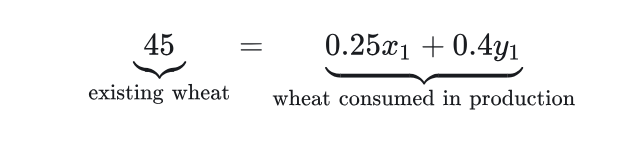
From this, the first equation could be obtained, the wheat consumption equation:
4) steel consumption
Next, how much steel is consumed in total for the production of x1 wheat and y1 steel?
By following the above analysis, it can be concluded in the same way that,
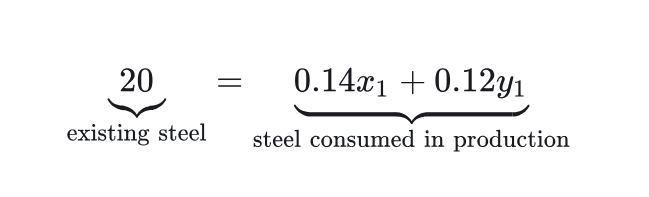
Therefore, if the 20 tons of steel as the initial resource is invested in production, the steel consumption equation that can be obtained is:
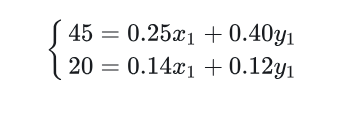
When combined with the equation for wheat consumption, a system of growth equations is obtained:
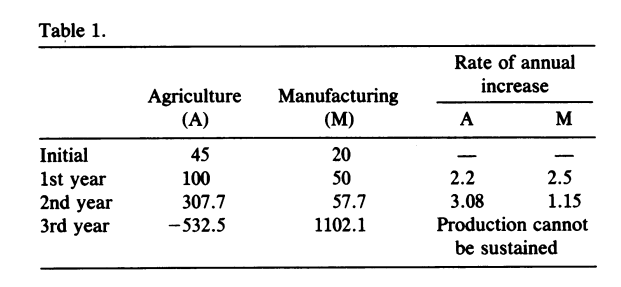
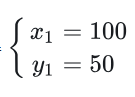
So at the end of the first year, the output of wheat(x1) and steel(y1) was:
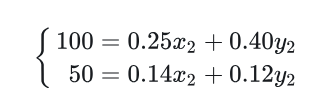
Similarly, in the second year, if the 100 tons of wheat and 50 tons of steel produced at the end of the first year are continued to be used for production, let the output of wheat and steel in the second year be and respectively, then the growth equation in the 2nd year can be obtained as follows:
And the output at the end of the 2nd year was:
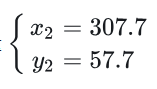
However, something strange happened.
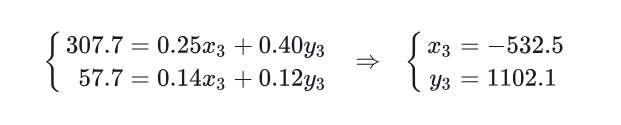
After going through the same process in the 3rd year, the output of wheat turned out to be negative.
In contrast, the increase in the output of steel was extremely significant (the growth equation for the 3rd year and its solution are as follows):
So where is the problem?